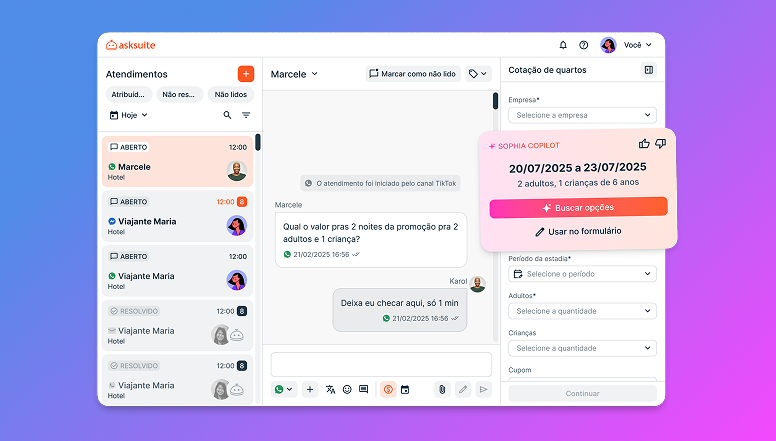
Asksuite's LiveChat with Sophia Copilot: the AI reads the conversation ("How much are the 2 nights on the promo for 2 adults and 1 child?") and pre-fills the room quote with the stay dates (07/20–07/23/2025) and guests (2 adults, 1 child aged 6), offering two actions: Buscar opções (Search options) and Usar no formulário (Use in form).
Increasing quote volume by 40% with Artificial Intelligence
How I led the design of the manual quote automation project that cut the time to manually quote room rates by 73% and increased quote volume by 40%.
DISCLAIMER: Sorry, dear reader: the project is real, but this text was written by AI and it's a pretty boring read… I'm rewriting my case studies with my own two handz, I just can't leave this page empty. It's still a great case — just a bit dull to read.
Role: Product Designer
Impact: -73% time (178s → 48s) | +4 quotes/day per user | +14pp CSAT (52% → 66%) | 480K analyses | 70% retention
Timeline: Q2-Q3 2025
Context: The company's strategic goal was to integrate AI into its products. I identified quoting as the ideal opportunity.
The business
Asksuite is a global hotel intelligence platform, voted the world's best chatbot for hotels for several consecutive years at the Hotel Tech Awards. The company focuses on increasing direct bookings and operational efficiency for hotels and resorts through conversational technology.
In hospitality, response time is crucial. When a traveler asks for a quote via WhatsApp or Instagram, a delay of just a few minutes can mean losing the sale to a competitor or to a large OTA (like Booking.com). On top of that, reservation teams spend around 60% of their time on repetitive tasks, such as copying and pasting data from conversations into property management systems (PMS).
The challenge
Amid the Generative AI hype, our challenge wasn't just to "implement AI", but to find where it would solve a real pain. We focused on the most critical bottleneck in hotel operations — booking quotes — and built a solution that empowers the human agent instead of replacing them.
-73% Quote time
+40% Quote volume
+14 p.p. in CSAT (from 52% to 66%)
How might we use AI to unlock agent productivity, balancing a fast implementation with high perceived value?
The Problem: Identifying the Opportunities
Based on user interviews and satisfaction survey data, I identified 3 opportunities:
Delete/Edit messages (SpellChecker)
✅ Frequently requested by users
❌ Only feasible via integration with Gupshup (out of scope)
❌ Little market appeal
Keyword search within the conversation
✅ High perceived value for users
❌ Very high technical complexity (according to the tech lead)
Quote assistance
✅ A critical feature used 10x/day per active user
✅ High direct value for customers (increases conversion)
✅ Balance between technical feasibility and value delivery
✅ On-demand solution (keeps costs under control)
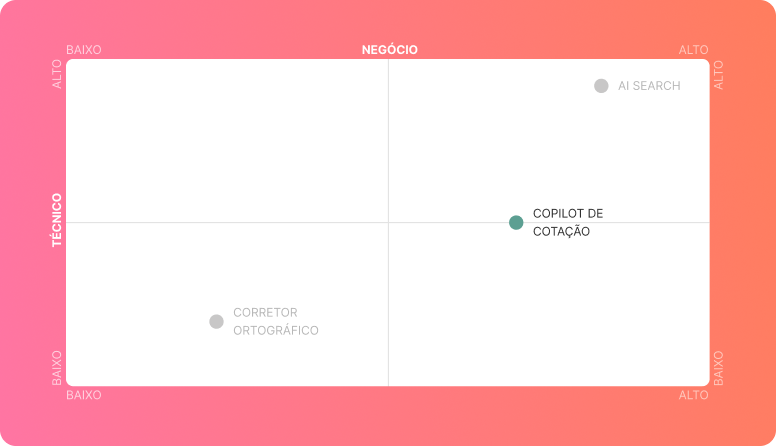
Prioritization matrix: business value (negócio, horizontal axis) vs. technical complexity (técnico, vertical axis), from low (baixo) to high (alto). The spell checker (corretor ortográfico) has low business value and low complexity; AI search has high business value but very high technical complexity; and, highlighted, the quote copilot (copilot de cotação) combines high business value with medium technical complexity.
We dropped peripheral features and those with high technical risk to tackle the quote flow, which happens ~9x a day per user and was the biggest drag on CSAT (52%).
Validating the Problem
CSAT among users who selected problems related to the "Speed of actions" topic and the "Quotes" subtopic was 52.63% (below the overall target of 77%). And the average time to fill in a quote was:
- 178s for conversations where travelers sent all the necessary information in one or two messages
- 240s+ for conversations where the agent had to hunt for the information throughout the conversation
Insight: We could reduce the time needed to send quotes, which would increase:
- Number of quotes per user/day
- Conversion rate
- ROI for client hotels
Current journey and opportunities
Agent opens the conversation → Analyzes the conversation → Opens the quote app → Finds the information in the conversation → Fills in the form → Searches for options → Analyzes the room list → Selects options → Sends the quote

| Opportunity | Can AI do it? | Feasible? | Decision |
|---|---|---|---|
| Identify a quote request when opening the conversation | ✅ | ❌ (high cost, many false positives) | Discarded |
| Extract quote data | ✅ | ✅ | ✅ Selected |
| Fill in the form automatically | ✅ | ✅ | ✅ Selected |
| Recommend rooms | ✅ | ❌ (depended on customers providing full room descriptions) | Discarded |
| Select rooms automatically | ✅ | ❌ (depended on the recommendation above) | Discarded |
Strategy: Focus on extracting data + filling in the form. This removes the largest number of required interactions.
Solution
In our initial hypothesis (V1), the AI extracted the data and the only available action was searching for options.
Usability tests helped us understand that agents could feel unsure about the extracted data, and that they might also need to change some of it.
In V2 (final), agents could either search for rooms directly with the extracted data or use it to fill in the form.
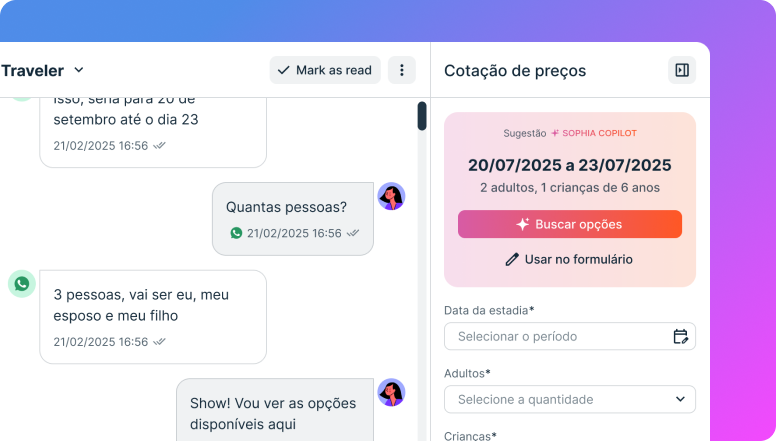
The shipped solution: a side drawer next to the conversation with the price quote form (Cotação de preços) and, on top, the Sophia Copilot suggestion card with the details the AI has already identified — 07/20/2025 to 07/23/2025, 2 adults and 1 child aged 6 — and two actions: Buscar opções (Search options) and Usar no formulário (Use in form). In the chat, the traveler explains it will be 3 people: "me, my husband and my son".
Beta rollout
To mitigate risk, we avoided a big-bang launch. We designed a phased go-to-market strategy:
- Beta phase (high touch): We first released it to close customers (in touch via WhatsApp). This let us catch critical bugs and slow analyses in real time.
- 50% phase (data driven): We added feedback components (like/dislike) directly in the UI. If users gave a thumbs-down, they could categorize the error (Too slow? Wrong?). This produced data to refine the model before scaling up.
- General release: Only after error metrics stabilized in the betas did we release it to 100% of the base, including international customers.
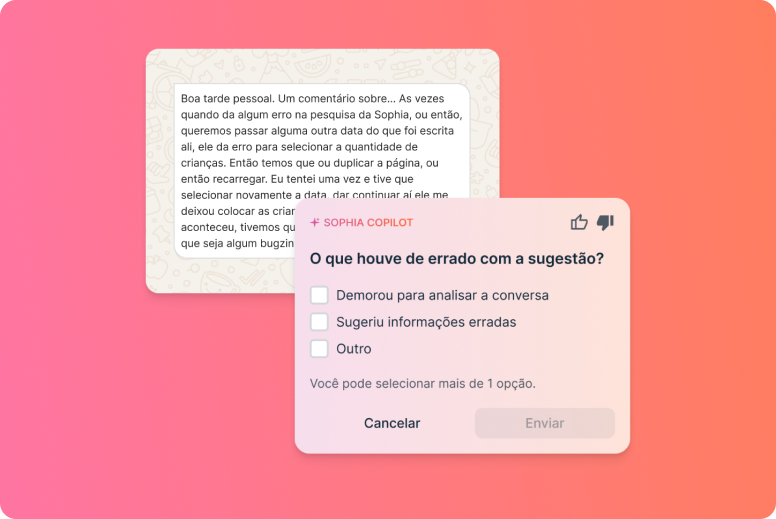
Left: a message from a beta customer reporting that when Sophia's search gets something wrong, or when they want a different date from the one suggested, selecting the number of children throws an error, so they have to duplicate or reload the page. Right: the feedback component shipped in the 50% phase — after a thumbs-down, the agent is asked "What went wrong with the suggestion?", with the options It took too long to analyze the conversation, It suggested wrong information and Other (more than one can be selected).
Launch
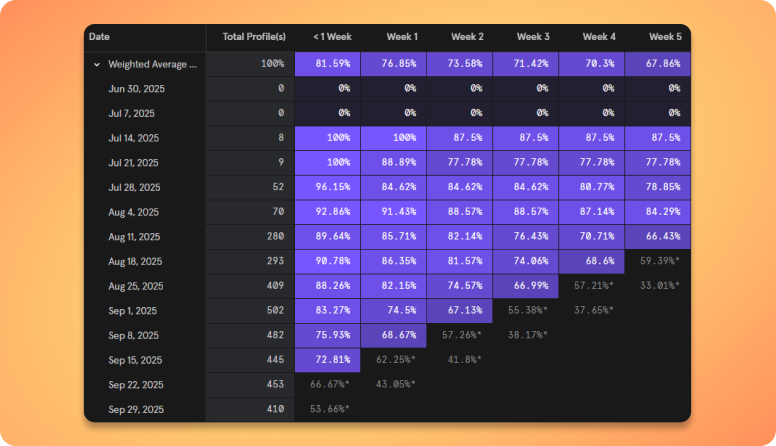
The strategy ensured adoption without losses, with 70% retention. Average time dropped to 48s (from 178s). That speed allowed a 40% increase in daily quote volume per user and, more importantly, quote CSAT rose from 52% to 66%.
Usage Metrics
| Metric | Value |
|---|---|
| Analyses performed | 480K+ |
| Retention through week 4 | 70% |
| Unique users | 1,100+ |
Impact on Quotes
Before (07/28 – start of Q3, without Copilot):
- Average: 10 quotes/user/day
- Daily volume: 7.8K
- Unique users: 624
- Conversations: 34K
After (09/29 – end of Q3, with Copilot):
- Average: 14 quotes/user/day (+4 per user = +40%)
- Daily volume: 10.8K (+38%)
- Unique users: 680
- Conversations: 34K (unchanged)
More quotes without more conversations = agent efficiency.
Impact on Satisfaction
| Metric | Before | After | Delta |
|---|---|---|---|
| Quote CSAT | 52.63% | 66% | +13.37pp |
Impact on Time
| Metric | Before | After | Delta |
|---|---|---|---|
| Time from opening the app → searching for options | 178s | 48s | -130s (-73%) |
Operating Cost
- Daily AI cost: US$3/day
- Fully on-demand (pay as you go)
- ROI: Considering +4 quotes/day = higher conversion, the cost is negligible.
Next Steps
Problem Identified: Room Selection
In weekly interviews, agents also reported:
- Looking up information in room descriptions
- Understanding travelers' preferences (balcony, TV, etc.)
- Average time: 4 minutes between searching for options and sending the quote
Roadmap
Steps 3-4 of the funnel (room selection):
- AI recommends rooms based on preferences mentioned in the conversation
- Reduce selection time (currently 4 min)
- Increase accuracy (better chance of closing the deal)
This would naturally be the Copilot's next evolution.
Conclusion
Quote Copilot was more than a feature — it validated a process:
- Identify problems with data (52% CSAT on quotes)
- Evaluate options strategically (3 hypotheses, 1 feasible)
- Validate in phases (beta → 50% → 100%)
- Measure real impact (time, volume, satisfaction)
- Build for scalability (design system, tokens)
Result: A project that moved a real metric (+13pp CSAT) at a low cost (US$3/day), with learnings for future AI features.